
 Loading more
Page 5
Harry Houghton was born15th December1891. He was the son of Edward and Martha Houghton of Scholes Fold, Pickup Bank, Darwen who were farmers. Harry helped his father and his brother William on the farm.
Harry enlisted into the 3rd Coldstream Guards in September 1915, having initially avoided army life as a reserved occupation as a farmer.
It was during the Battle of Morval, on 26th September 1916, that Harry was killed. The preliminary bombardment began at 7am on 24 September; the assault troops waiting in muddy ‘jumping-off’ trenches early next morning witnessed a barrage of unprecedented ferocity on German positions, which intensified just before zero hour. At 12.35pm on 25th September, as the creeping barrage pounded down on No Man’s Land, the infantry advanced. On XIV Corps front 5th, 6th and Guards Divisions methodically gained ground and both Morval and Lesboeufs were occupied by 3.30pm. XV Corps divisions had difficulty approaching the formidable Gird Trench and considerable disorganisation was caused by determined German resistance. It was not until early morning on 26th September that a section of Gird Trench was cleared, with the assistance of a tank, opening the way into Guedecourt village, which was taken that same evening. Earlier in the day Combles had been occupied by British and French forces. Further attacks were made by XV Corps on 27 September and the following day saw the handover of the extreme right of XIV Corps line to French forces.
During this engagement, it was initially reported that Harry was wounded, with shrapnel in his left hand, but he was later listed as killed, presumably suffering from complications due to the wound. Despite getting to an aid station, Harry’s body was never found, and he has no known grave. He is remembered on the Thiepval Memorial to the Missing on the Somme.
Lancashire Fusiliers, 13530
Private Robert Ingham of the Lancashire Fusiliers (No 13530) was killed in action on the 1st of July 1916. John was born in Darwen in 1890. His siblings were Nancy Alice, James and Annie.
Prior to the war he was a footballer who played for Darwen. He was employed at Messrs. Places Pipeworks Eccleshill and attended Blackburn Road Wesleyan School.
Robert enlisted into the 1st Battalion Lancashire Fusiliers in March 1915. He travelled with the Battalion to Gallipoli and engaged in actions at the Battles of Krithia and the Achi Baba heights on the Gallipoli Peninsula. In January 1916 they were evacuated to Egypt due to the severe casualties from combat, disease and harsh weather. From here, they embarked for France, landing at Marseilles on the 29th March 1916. For the next three months, Robert would get an understanding of the Western Front, before being sent into action on 1st July 1916. The Battalion were based at Beaumont Hamel. The Sunken Road was in “No Man’s” land on the morning of the 1st July 1916. Its situation made it too dangerous to hold by either side, though the Germans probably held the advantage through their dominance of the higher ground. The Lancashire Fusiliers would have been advancing from left to right. The German’s position, called the Bergwerk, was slightly to the right of the small British Cemetery on the hillside.
By 0300 hours on 1st July 1916 two companies of the Fusiliers had moved into the Sunken Road. The British bombardment was still going on and this would have helped keep German patrols away. At 0720 hours the Hawthorn mine was detonated and of course the British bombardment in the area had to stop because on the far side of the hill the 2nd Royal Fusiliers were rushing the crater.
By now it was broad daylight and the Germans had already spotted the Lancashire’s waiting below them. The German artillery put down a bombardment of their own.
At 0730 hours – ZERO hour – the Lancashire’s rose up out of the Sunken Road moving leftwards. They were cut down within a matter of metres.
The remaining Companies advancing from the British front line into the Sunken Road also suffered heavy casualties whilst leaving their own trenches.
By lunchtime the Sunken Road was simply a point of refuge for the dozens of wounded. These were evacuated during the remainder of the evening and the position was held through the night by just one officer and 25 men.
The Battalion had lost 163 killed, 312 wounded and 11 missing.
Robert has no known grave, but is remembered on the Thiepval Memorial to the Missing on the Somme, Pier and Face 3c and 3d.
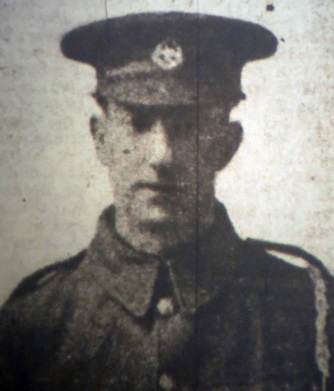
East Lancashire Regiment, 14917
Private Richard Thomas Davenport Jackson of the 8th East Lancashire Regiment (No. 14917) was killed on 15th July 1916 at Pozieres on the Somme.
Richard was born 5th July 1880 in the Ashton area of Wigan and baptised 26th July 1880 at All Saints, Wigan, the son of William Jackson and Ann (nee Davenport). By 1891, the family had moved to Darwen and were living at 7 Back Bolton Street, Darwen. At this time Richard was working as a “half-time” cotton weaver. Later the family moved to 16 Star Street, Darwen. Richard subsequently was employed as a full-time weaver at Springfield Mill. He attended Holy Trinity Church where he married Betsy Jane Bennett in 1902. They had one child, William Henry, who was born in 1903. They later lived at 35 Essex Street, Darwen.
Richard enlisted by November 1914 when he was living at 35 Queens Street, Darwen and joined the 8th East Lancashire Regiment. The Battalion was formed at Codford, Wiltshire and moved to Pokesdown Bournemouth in November of the same year. It is most likely where Richard joined the Battalion. Towards the end of March 1915, the Battalion had moved to Salisbury Plain and were concentrated at Cholderton. On 25th June, the units were inspected by George V at Sidbury Hill. On 22nd July 1915 the Division began to cross the English Channel, with Richard arriving at Boulogne on 1st August 1915. By 2nd August all units were concentrated near Tilques.
By June 1916, the Battalion was based at Bienvillers on the Somme ready for the “big push.” For some weeks prior to 1st July 1916 the role of the Brigade had been to induce the enemy to expect an attack from the Brigade front. With this object the Battalion’s patrols had been very active in no-man’s land and several raids had been carried out and much ammunition used. On 1st July the role of the Brigade was to form a defensive flank to cover the flank of the 46th Division during its attack on Gommecourt. Between 1st and 14th July the Battalion had suffered heavy losses. At 8am on 15th July the Battalion received orders to attack Pozieres and capture the village. The Battalion again suffered heavy losses and it was here where Richard lost his life.
His widow was informed of the loss a few weeks later and received the following letter from a colleague of her husband’s which published in “The Darwen News”, Saturday August 12th, 1916:
“It is with much regret that I write you these few lines to offer you the deepest sympathy of my comrades and myself in conveying to you the news that your husband, Richard, was killed in action on Saturday, July 15th whilst bravely doing his duty. He was a splendid fellow and he will be very much missed in the machine gun section, and by all who knew him. He was quite near to me when he fell, and he did not suffer much pain; he died almost instantaneously. My chums and myself sincerely hope that you will bear up as well as you can in your sad bereavement. We have the consolation that he died bravely fighting for his King and country. So once again we offer you our heartfelt sympathy in your loss.”
Richard Thomas Davenport Jackson is remembered on the Thiepval Memorial to the Missing on the Somme and has no known grave.
East Lancashire Regiment, 6187
Private Joseph Jefferies of the 1st East Lancashire Regiment (No 6187) was killed on 1st July 1916 close to by Redan Ridges on the Somme.
Joseph was born on 19th March 1882 at Catlow Fold, Darwen. He was the son of William Jeffers and Mary (nee Rush). On 29th July 1899 he attested at Preston for the 3rd Loyal North Lancashire Regiment 47th & 81st Foot (No 6454) and gave his age as 17 years 4 months. At the time, he was working as a labourer for Mr Shorrock of Darwen. His details were recorded as follows: height 5ft 7½ ins; weight 126lbs; chest 32½ins (with an expansion of 2ins); complexion fresh; eyes grey; hair brown; religion Roman Catholic; scar back of left hand; brown mark right hip. Joseph joined the Regular Army 19th October 1899. Attested: 19th October 1899 East Lancashire Regiment – 30th & 59th Foot (no. 6095) and gave his age as 18 years; occupation labourer. Height 5ft 7¼ ins; weight 122lbs; chest 33½ins (with an expansion of 2ins); complexion fresh; eyes grey; hair brown; religion Roman Catholic; scar back of left hand and left eye brow.
His army record shows that he saw service at home from 19th October 1899 – 27th June 1900. He later saw action in South Africa from 28th June 1900 – 24th April 1902. Further service followed in India 26th April 1902 – 18th March 1908, and again, 4th September 1908 – 1st November 1911. He was discharged on the completion of 12 years’ service on 4th November 1911. On 13th November 1900, whilst in India, he received a Court Martial for sleeping whilst on duty as a sentry and he was imprisoned for 56 days. Joseph was promoted to Lance-Corporal on 9th November 1903 and then to Corporal on 14th July 1905. He was appointed as Lance-Sergeant on 3rd October 1908 and Sergeant on 20th January 1910.
He received the Queen’s South Africa Medal with clasp for Orange Free State, Cape Colony and Transvaal and the King’s South Africa Medal with clasp for 1901 and 1902.
On the outbreak of war he re-enlisted at Blackburn and joined the 1st East Lancashire Regiment (No. 6187). At this time he was living at 35 Exchange Street, Darwen. He was drafted on active service in January 1915. He was with his Battalion at the Second Battle of Ypres. From Ypres the Battalion moved south and in May 1916 they were undergoing intensive training for the forthcoming offensive. Platoon training and musketry took place at Bernaville. On 11th June the Battalion marched to Mailly-Mailett and on 1st July the Battalion was just north of Beaumont-Hamel close by Redan Ridges and, it was here, that Joseph lost his life. It would be almost twelve months before his mother was informed of her son’s death.
“The Darwen News” published his obituary notice on 16th June 1917 and mentioned that a brother had been killed on 21st April 1916. This would have been John who was killed in Iraq and he his remembered on the Basra Memorial.
Joseph Jefferies is remembered on the Thiepval Memorial to the Missing on the Somme and has no known grave. He is also remembered on the War Memorial at Sacred Heart and St. Edward’s.
At the end of the war his mother received Joseph’s war medals - Victory & British War Medals; 1914-1915 Star.
Border Regiment, 16464
Lance-Corporal Herbert Jepson of the 8th Border Regiment (No. 16464) was killed on 5th July 1916 at Aveluy Wood, part of The Battle of Albert.
Herbert was born in Burnley on 1894. He was the son of James Robert Jepson and Mary (nee Jones). His birth was registered under the name of Ebbe Herbert. The family moved into Darwen shortly after 1897 and, by the time the 1901 census was taken, the family were living at 3 Ellen Street, Darwen. He attended Bolton Road Congregational Sunday School and worked as a weaver at Greenfield Mill.
When War was declared Herbert attested 2nd November 1914 at Darwen and was posted into the 8th Border Regiment on 7th November 1914. His army record gives his height as 5ft 8ins, chest 33ins (and an expansion of 2ins), complexion: sallow, eyes: hazel and his religion as Congregationalist.
He received his initial training at Codford at Salisbury Plain in Wiltshire. In early 1915, the Battalion moved to Aldershot for Brigade training, where the men learned the arts of soldiering in large formations. Having completed this training it was time for the 8th Border to move for service overseas into the war zone. After a spell of leave at home, the men gathered at Codford Camp and prepared to travel to the Western Front. Whilst at Aldershot, Herbert got a taste of army discipline when on 19th July 1915 he was confined to barracks for ten days for not complying with an order to shave upper lip. On 12th August 1915, he was appointed unpaid Lance-Corporal.
The Battalion left Aldershot on the 25th September 1915, arriving in France on the 27th , at the Port of Boulogne. On arrival in France, they travelled by train to Hazebrouck, marched to Strazeele and took lorries to Nieppe then marched on to Le Bizet where they were billeted. From here, they went into the line at Ploegsteert for the first three months of "acclimatisation", as they learned the 'arts and tricks' of Trench Warfare under the guidance of the 48th Canadian Highlander Battalion.
Once they were trench ready they began trench warfare's cycles of front line, reserve line, rest and fatigues, as and when needed. The Battalion started a period of turn and turnabout with the 10th Cheshires in line at East of Ploegsteert.
The nights of 4th – 9th October were full of sniping and machine gun fire from the enemy as the 8th Border tried to repair and reinforce the trenches in their sector. On the 9th they were relieved to billets at Ploeagsteert, exchanging places with the 10th Cheshire’s who went into line, in their place. The 10t -15th October was spent in the second line, doing fatigues and physical drills, followed by bathing. On the 15th October they went back into the front line to relieve the Cheshire’s again. The front line was as active as the first tour and the following gives a flavour of the action.
November and December 1915 were spent in poor weather in this area. Most of the Battalion activity concerned trench repairs and sniping duels. On as lighter note, one of the British snipers bagged a pheasant ! Christmas this year was most definitely not a time for fraternisation and although the 8th Border’s were out of line and had Christmas Eve bath and a service on Christmas Day.
During the early part of 1916 the 8th Border were in training for the upcoming offensive of the summer months; the British and French planned to break the German lines and win the war. Periods of training were alternated with periods in line and a gradual progression to be in the area of attack in time for the 'Big Push' (The Battle of the Somme). On 26th January 1916 the 8th Border, part of the 75th Brigade, 25th Division moved via La Creche, to Strazeele, where the men had Company Training. General Plumer and Lord Kitchener inspected the Brigade during route marches and some men attended a demonstration of the new German weapon, the Flammenwerfer.
On the 10th March 1916 they left Strazeele and moved to Nedon and Bryas for more training, all in preparation for the upcoming summer offensive. Sir Julian Byng inspected the men on 20th March 1916 and Sir Douglas Haig on the 31st, all while the men were on route marches. Things were beginning to ramp up now, as Wood Fighting in defence and attack, night fighting, bombing, training against the German Flammenwerfer and musketry and Lewis Gun firing was practised.
In early April, training continued for preparation to go in line north of Neuville St Vaast on the 21st April 1916. Whilst in line early in their stint, in the pouring rain, struggling to maintain the trenches, the Germans decided to test the 'new boys'. On 25th and 26th April 1916 the front line was subjected to a set of bombing raids which cost the lives of two men. May 1916 was spent in and out of line in the Neuville area and it was here the 8th Border got its first real taste of two notorious facets of Western Front warfare; mining and gas.
The 8th Border went out of line on the 20th May 1916, but they were harassed in Neuville by gas shells and heavy calibre shelling during their time in billets. They returned to the front line in late May and received a spate of casualties, due to mining bombing and shelling as the enemy sought to make the area as uncomfortable for the troops as they could. Rumours of the build up to the “Big Push” must have been rife on both sides of the line. June 1916 saw the Battalion moving towards the Somme Area, training and exercising as they went. The training was aimed at getting the men into a peak of battle readiness for the Battalion’s part in the Somme Offensive, set for the end of June or early July. On 12th June 1916, Herbert reverted to Private at own request but it is unclear as to when he was appointed as Lance-Corporal.
When the Battle of the Somme commenced, the 8th Battalion was stationed at Forceville, some four miles behind the front lines, but ordered to be ready to move up at short notice, if events required. On the 2nd July 1916, they were marched to Martinsart Wood and the front lines south of Thiepval, to take part in an attack at 6 a.m. on July 3rd, in an area which had resisted attackers the previous day. With no attack taking place either side and severe enfilade fire from these flanks, the attack was costly to the 8th Border. The German trench was only captured for 200 yards in the centre of the attack and this was too badly damaged by shellfire to hold against counter attack. The men had to hold the line for another night as the battered 32nd Division who had attacked on the 1st July in this area, were in greater need of relief due to their higher casualties. The 8th Border were relieved on the night of the 4th July and bivouaced in Aveluy Wood as they and other Division battalions recovered from the failed attack. It was here that Hebert lost his life but his body was never found.
By July 1916 Herbert’s father had been informed that his son was missing but it would be another ten months before his death was confirmed. His family received Herbert’s 1914-14 Star on 21st June 1921 and his Victory & British War Medals on 10th December 1921.
Herbert Jepson, aged 22, is remembered on the Thiepval Memorial to the Missing on the Somme, and has no known grave. He is also remembered on the Bolton Road United Reformed Church’s War Memorial.
back to top
East Surrey Regiment, 10131
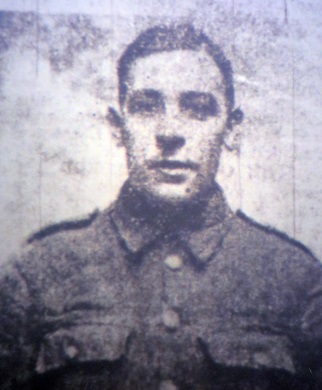
Royal Irish Regiment, 846
Jeremiah Leach was born in 1890 to Thomas and Jane Leach of 35 Carr Street, Darwen. Jeremiah had an older brother, George, and, by 1911, he was an apprentice joiner. He was also married, to Edith Eccles.
Jeremiah enlisted into the Somerset Light Infantry at the outbreak of war, although was quickly transferred to the 2nd Royal Irish Regiment, in time for training for the Gallipoli Campaign. He took part in the historic landing at Suvla Bay but was wounded and sent home. He recovered in enough time to return the Battalion, which had moved to France.
In July 1916 the Royal Irish Regiment were transferred to 7th Division, and took part in the Battle of Bazentin Ridge.
On their right of the ridge was the 7th Division which, having been faced with over 1,000 yards (910 m) of no-man's land to cross, had crept its assaulting Battalions within 100 yards (91 m) of the German wire when the bombardment lifted. The 7th Division were faced with a complex of German trenches — Flatiron Trench, Marlboro Trench and The Snout — beyond which lay Bazentin le Grand Wood but they reached all their objectives. By mid-morning these two XV Corps divisions had captured the village of Bazentin le Petit.
It was here that Jeremiah was killed. Sources differ on the date, although officially killed on the 14th July 1916. He had two photographs in his hand when he died, one of them being his wife. His body was never found.
Jeremiah Leach is remembered on the Thiepval Memorial to the Missing on the Somme.
East Lancashire Regiment, 24622
William was the second son of James and Hannah Leach of Hoddlesden, Darwen. A healthy family, his mother had 6 children all of whom survived infancy. The family would spend their working life as labourers, whilst William worked as a “Rover” in a cotton mill.
William enlisted into the 8th Battalion East Lancashire Regiment in 1915. Leaving for France in early 1916, William arrived just in time for the Somme Offensive, where the Battalion was engaged throughout the summer.
It was November 16th, however, when William was killed. The war diary for the Regiment reads:
At 1.30a.m. the battalion proceeded to the trenches north east of Beaumont Hamel arriving in trenches about 7.45 a.m. in a thick fog. At 8.30 a.m. after a preliminary bombardment the battalion advanced in two waves.
It advanced a considerable distance (200 yards) in the fog before the enemy knew the attack was in progress. As soon as the enemy observed the attach, he opened a heavy machine gun and rifle fire. The forward wave got up to within 50 yards of Munich trench when our filed gun barrage commenced. It was owing to this barrage being short, the thick fog and the wire in front of our trench being uncut that the main attack failed.
The casualties during this attack were very severe. By 10.00a.m. the attack had ceased. The rest of the day was occupied in consolidating a position.
On 16th/17th the battalion was relieved by one company of a border regiment.
William’s date of death is given as 16th November but it would appear likely that he was actually injured on the 15th and subsequently died of his wounds. He has no known grave but is remembered on the Thiepval Memorial to the Missing on the Somme.
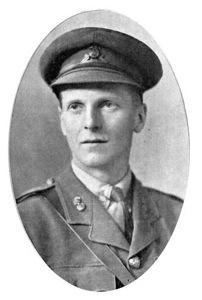
Lancashire Fusiliers, 24622
Eustace was born in 1889 in Whalley and he was son of Arthur Longworth and Susan Margaret Peterkin. His father, Arthur, of Clerk Hill, Whalley was the Chairman of the Darwen Division Conservative Association.
He was a student at university when war broke out in 1914. Given his advanced learning, it is unsurprising that he received his Captain’s Commission quite quickly in 1915. He enlisted into the 9th Lancashire Fusiliers, just in time to join the Battalion as it set of for the Gallipoli Campaign.
On 17th July 1915 the Lancashire Fusiliers arrived in Alexandria and then moved to Imbros. They finally landed at Sulva Bay, Gallipoli on 6th August and then the Division engaged in various actions including the Battle of Scimitar Hill and attack on Hill 60.
They were evacuated to Mudros in December 1915 due to the severe casualties from combat, disease and harsh weather.
After six months in Egypt defending the Suez Canel, the Battalion moved to France landing at Marseilles and then engaged in various actions on the Western Front including the capture of the Wundt-Werk (Wonder Work) and The Battle of Flers-Courcelette. It was at Flers-Courcelette that Captain Longworth was killed.
Captain E C Longworth, aged 27 years, was killed in action on 26th September 1916 and he is remembered on the Thiepval Memorial, Pier and Face 3 C and 3 D.
His name is also recorded on Mostyn House School War Memorial and at Manchester University.