
 Loading more
Blackburn Men and the Battle of Trafalgar
The battle fought off the south-west coast of Spain near Cape Trafalgar on the 21st October 1805, which became immortalised as The Battle of Trafalgar, marked the affirmation of the Royal Navy’s pre-eminence over other navies. The victory ended the prospect of a French invasion.
Lancashire provided 556 men (1) in that epic encounter with the combined French and Spanish fleets. The Navy’s supremacy developed out of many battles and campaigns against French, Spanish and Dutch fleets during the previous century, and the defeat of the Danish fleet in 1801 at the Battle of Copenhagen. The Navy did not win them all, but it did learn from setbacks. This growing superiority in ships, men and armaments led to the triumph of 1805 (2). Following Trafalgar, the Royal Navy reigned more or less supreme upon the world’s oceans until the next century, although towards the end of the nineteenth century other navies began to pose a growing challenge. Today the Royal Navy is a mere shadow of its former self.
The Navy’s dominance in the nineteenth century enabled the formation of the Preventive (West Africa) Squadron, based in Freetown, Sierra Leone, from 1819. The Squadron provided military muscle when necessary in order to enforce the Act for the Abolition of the Slave Trade, which was passed in March 1807, dedicated to the elimination of the Atlantic slave trade. It cost the Admiralty much treasure, and the blood of over 17,000 sailors who died from various causes (3).
Of the 556 Lancashire men who fought at Trafalgar, 225 came from Liverpool (4). Liverpool was becoming the pre-eminent English port on the western seaboard (and that pre-eminence included a substantial role in the horrific Atlantic slave trade) as it gradually superseded Bristol and Chester. Manchester, at that time not reachable by ocean-going ships prior to the opening of the ship canal, provided 121 men.
Blackburn had four men serving on that momentous day:
John Isherwood served on HMS Colossus, a 74 gun third-rate ship of the line, as an Ordinary Seaman, a rank leading eventually to that of Able Seaman. Colossus suffered the highest number of casualties of any of Nelson’s fleet on that day with 40 sailors killed and 160 wounded. At that time ships and cargoes captured in battle were sold off and the ‘prize money’ was distributed among the crew or surviving relatives able to claim. The four month window available for claims, and various other factors, meant many next-of kin claims were not made (5). Two prize money pots were made payable to Trafalgar veterans. The normal prize money pot (the practice did not formally end until just after the Second World War) was much reduced because many of the captured ships were lost in a storm. Parliament voted a special Grant (£300,000) in 1806 as an additional prize fund. But various bureaucratic hindrances, or the fact that veterans were serving elsewhere at the time when the Prize Agent visited a Trafalgar ship, meant many missed out on the second prize fund. A sailor who missed the visit of the Prize Agent had to claim through a written process which illiterate sailors could find difficult. Eventually the balance of the unclaimed fund was given to Greenwich Hospital. John was a volunteer who joined Colossus from HMS Plymouth in April 1805. He had no injuries recorded, and was awarded prize money of £1 17s 8d. There is no record of John claiming from the second ‘Grant’ fund. Aged about 26 according to the records. Two baptisms of John Isherwood are recorded in the Bishop’s Transcripts for Blackburn St. Mary’s Parish Church in 1778. One of them lived in Over Darwen (Darwen) so almost certainly the other is the John Isherwood of Trafalgar.
- John Bridge was a 22 year old volunteer (6) landsman (a relatively recent recruit not yet experienced enough to have reached the status of Ordinary Seaman) who served on the Leviathan, a 74 gun third-rate ship of the line, having joined from HMS Wolverine in February the previous year. Awarded prize money of £1 17s 8d, John was later awarded the General Service Medal with a Trafalgar Clasp. There is no record of him receiving an award from the second ‘Grant’ fund. John did not quite have an exemplary record. He ‘Ran’ (deserted) in the Gulf of Palma from August to September in 1804. That John was awarded the General Service Medal means he lived to a good age since the award was made only to Trafalgar veterans still living in 1847. The crew of Leviathan were involved in a legal dispute over the capture of a Spanish ship, which was not settled until 1811. By that time many of the crew had been discharged, transferred or died meaning some never receive their share of the prize money.
- William Tomlinson was 27 years old at Trafalgar, an Ordinary Seaman serving on HMS Bellerophon on that day, having joined the ship four years previously from HMS London. William was a volunteer. Awarded prize money of £1 17s 8d, and £4 12s 6d Parliamentary Grant. William had long service in the Royal Navy, having joined HMS Vengeance in 1798 and served until 1813, his last ship was HMS Bedford. William was subsequently awarded a pension by the Admiralty in 1838. Bellerophon, a 74 gun third-rate ship of the line, was in the thick of the fighting at Trafalgar, engaging French and Spanish ships simultaneously. Her Captain and Master were killed. Over 25% of her crew were casualties. In 1815 HMS Bellerophon took the surrender of Napoleon while blockading the French port of Rochefort. A baptism of a William Tomlinson at St.Mary’s Parish Church, Blackburn is recorded in the Bishop’s Transcripts in July 1777 so it’s probable it is one and the same who fought at Trafalgar.
William Wray, a Boy 2nd class sailor, aged 18 (the boy classification for a sailor could last until the age of 18) served aboard HMS Prince, a 98 gun second-rate ship of the line. Recorded as serving on Prince in April 1804, which William had joined in September 1803 after serving on the Salvador del Mundo, a Spanish ship captured by the Royal Navy in 1797 and subsequently crewed by the British Navy. So William was an experienced sailor by the time of Trafalgar. Awarded £4 12s 6d from the Parliamentary Prize fund in 1806 and £1 17s 6d from the original prize fund in 1807. No one was killed in battle on HMS Prince, she was a slow ship and arrived late to the battle but still managed to inflict severe damage on the French ship Achille. Prince rescued survivors from the Achille, as was the customary ‘law of the sea’. Many of Prince’s crew were subsequently sent as prize crews on the captured enemy ships towed by Prince. When those ships later capsized in the storm, the muster rolls were often lost, and sailors then had no proof of their service to show to Prize Agents.
Other Lancashire towns provided sailors at Trafalgar. Bolton had thirteen and Preston nine sailors present at the battle. Two of the Preston men served on HMS Temeraire, a 98 gun second-rate ship of the line, which became known as Fighting Temeraire for her role in the battle when, sailing second in line behind the Victory, she rescued Nelson’s flagship from being overwhelmed by two French ships, capturing both in the process. The ship achieved artistic immortality in her dotage in 1838 when ‘The Fighting Temeraire’ was painted by JMW Turner as she was on her last voyage, while being ignominiously towed by a steamship to the breaker’s yard at Rotherhithe.
No sailors from Burnley or Accrington appear in the records. A carpenter on HMS Victory gave Downham as his place of birth, but there are several Downhams in England so he may not have been a Lancashire lad.
Notes
- Records of the men who served in Nelson’s 33 ship fleet (only 27 ships took part in the battle) are held in various archives, some material accessed via the genealogy websites Ancestry.co.uk and FindmyPast.co.uk. An excellent source of information is website ‘The 1805 Club’, whose homepage says: “information has been collected mainly from contemporary documents held at the National Archives – Kew, the Royal Naval Museum – Portsmouth, the National Maritime Museum – Greenwich, and the Royal Marines Museum – Eastney* The Roll contains the names and details of over 21,000 men who were on the musters of the British ships on 21st October 1805 (although still on the musters, some men had been discharged before the Battle)”. https://www.1805club.org
* Closed in 2017 pending opening of a new museum in the Portsmouth Dockyard.
- Since 1745 every ship in the Navy had to perform daily gunnery practice. Throughout the century rates of fire got faster and faster and the navy was usually able to fire repeat broadsides faster than the enemy. It often made a decisive difference when ships fought yardarm to yardarm. Ben Wilson, Empire of the Deep: The Rise and Fall of the British Navy. p390.
- Various stratagems were used by the British Government and the Navy to bring about an end to the vile Atlantic slave trade (the capturing and selling of African slaves by other Africans to Arab slave-traders continued), including diplomacy, bribery and military action on the sea and in inland expeditions. There was much opposition to the 1807 Act from both British and foreign sources that included false flagging of ships and legal challenges in Court. The 1807 Act lacked teeth, and so in 1811 a second Abolition Act was passed that transformed slave trading by Britons from a misdemeanour (punishable by a fine) to a felony which carried the risk of transportation to Australia. Sian Rees, Sweet Water and Bitter: The Ships that Stopped the Slave Trade.
- Ancestry.co.uk and FindmyPast.co.uk ‘Battle of Trafalgar Crew Lists’
- The prize money pots were distributed most unequally. Ordinary sailors received an amount not much more than a few weeks beer money (£4 12s 6d in 1806 is equivalent to around £500 today), whereas officers received life-changing sums. The Royal Marines present on deck were in just as much danger from musket, canon and grapeshot as the sailors yet were not rewarded equally.
- Many did volunteer to join the Navy. The notorious press gangs were seeking experienced seamen, including merchant seamen when found, rather than inexperienced landlubbers. Men who had never sailed on a ship before were not much use when the Navy needed to expand quickly in time of war. At the outbreak of war however, counties had to provide quotas of men for the Navy, and often took the opportunity to empty their gaols.
Sources
Rees, Sian, Sweet Water and Bitter: The Ships that Stopped the Slave Trade, London, 2009.
Wilson, Ben, Empire of the Deep: The Rise and Fall of the British Navy, London 2014
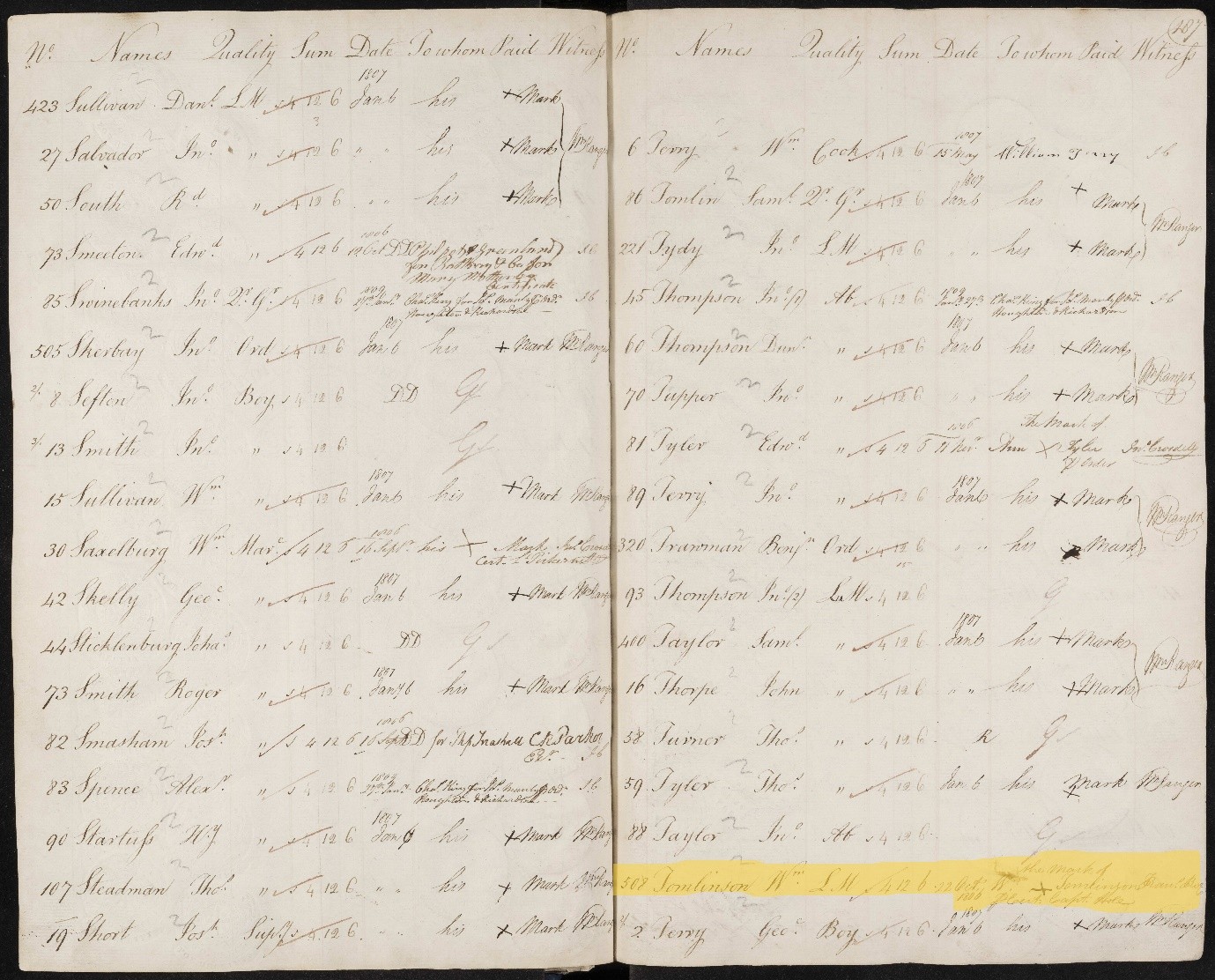
William Tomlinson’s award of £4 12s 6d recorded in the Ledger.
David Whalley, published July 2026.