
 Loading more
Foster Yates and Thom
Foster Yates & Thom
Alan Duffy’s Story
FOREWORD
The following is an account of my personal experience of working for FYT from 1952 to 1960 based on my actual memories of my time spent working there. It is as accurate as my memory now at 86 allows. Compared with modern times and Health and Safety the working conditions were very different but we got by without too many major safety issues. It is a story of times gone by.
PREFACE
FOSTER YATES & THOM
This Company was established in 1826 and my career there and the overall experience of working there had an enormous and lifelong effect on my subsequent career. From the first time I approached it to attend for interview I was overwhelmed by the immensity of the place. Walking up a street and approaching the factory there was a huge painted sign up on the wall it said:-
Foster Yates & Thom Ltd,
Canal Foundry
Heavy Precision Engineers,
Millwrights and Boiler Makers
Est. 1826
Absit Invidia [Absent from envy]
Every day I worked there I passed that sign and I never failed to marvel that after over One Hundred and Twenty six years these three founders of the Company still had their names up on the wall. What an amazing thing that was to me. I wondered if one day I might have my name up on my factory wall for all to see. Little did I know then what would come later in my life in that regard?
INTERVIEW
I was still attending school when I was invited to go to Foster Yates and Thom for a job interview for the position of engineering apprentice. This company was world famous and had been established in the year 1826. Everyone in our town and towns surrounding Blackburn knew of FYT or “Fosters" as it tended to be called locally. My mother's brother, my uncle Charlie had a good job there as did my dad Jack who worked in the steel bar stores. I had to create a good impression with Mr Pheasey the works manager who was going to interview me. I was nervous because he was known to be strict and a bit fearsome but fair to according to my dad and my uncle Charlie.
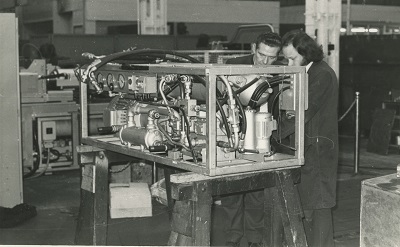
Charlie Lindow is the man on the left
When I arrived at the factory I was overwhelmed at the enormity of it. There were two main buildings one either side of Manner Sutton Street various noises emitted from the buildings. Bangs and clangs within a deep humming sound of what must have been machinery running. It all sounded very busy and exciting. There was an interesting smell around the place too. On the road just past the office entrance which was my destination. I noticed a horse and cart standing there the horse snuffling in a bag of food draped over its head the driver must have been inside the works. I learned later that this Shire horse was called Dolly and she and her driver were responsible for taking engineering parts from one factory to another. It seems it was cheaper than using Lorries. You will read about this pair later!
I opened the door with a little trepidation and introduced myself to the receptionist who was expecting me she asked me to sit down and someone would come and get me. Another boy came in whilst I was waiting he looked as nervous as I felt. Almost immediately someone came to show me to Mr Pheasey's secretary's office to await my turn for interview. She talked to me asking friendly questions and was very pretty and I soon felt relaxed. Mr Pheasey was the Works Manager. I later found out he was known as Mr Fosters. He had worked at the company for many years and ran most aspects of it and on engineering production matters there was nothing he didn't know and despite his tough approach everyone thought he was very fair and respected him immensely. As the saying goes “he ran a tight ship" I didn't realise at that moment that me a simple apprentice would cross his path many times in the future.
Very soon the secretary's phone buzzed and I was ushered into his office. He asked me to sit and asked why I wanted to be an engineer I replied “I want to be like my uncle Charlie" he said you will have to work hard to achieve. But we can give you every opportunity to do that. I then said I hoped to be a draughtsman. He told me I would have to go to Blackburn Technical College before that could happen and achieve the Ordinary National Certificate in engineering. He told me I would be given full day release including a night each week to educate myself to the level required. But when I reached the age of 18 I would have to attend at nights after work. He asked me if I wanted to be a craft apprentice or an indentured apprentice. I hadn't a clue what that meant. Craft is concentrating on a specific sphere of shop floor engineering e.g., operating machinery lathes, milling machines, borers, etc. or fitting machines together. Being indentured meant spending variable periods of time in all the departments so you gained a good spread of knowledge of everything the firm did. I opted for the latter thinking that having full engineering back ground would better help me if I became a draughtsman. Mr Pheasey said that was a good decision. I became relaxed and he asked me several more questions including what I did in my spare time. I told him swimming, football and music. Almost before I knew it the interview was over he stood up shook my hand and said we will let you know within a week.
My parents were eagerly waiting for the story when I returned home and were pleased for me. A few days after a letter arrived telling me I had got the job and I would start as Office Boy in the drawing office I would work there till Christmas then move on to the Blacksmiths shop .
I returned to my school Blakey Moor Boys School in the centre of the town to finish that period of my education. I enjoyed my time at this school and made many friends. After a family holiday with my parents to the Isle of Man. I left my childhood behind with no regrets and looked forward to an exciting future.
STARTING WORK FOR THE FIRST TIME
Two weeks later with my father I walked to work for the first time. It was a strange experience being admitted into adult life. I was a little nervous but very excited all at the same time. As we were nearing the factory we turned left into Quarry Street and there in a short distance was Canal Works, the home of Foster, Yates and Thom Ltd. As we got closer I saw the huge painted sign high up on the building.
We stood there for a few minutes to let what I was reading sink in, without really thinking I asked my dad if any of those peoples whose name was up there were still alive. Of course not, but their names are not forgotten after all this time! This moment has lived in my mind all my life. Then my dad gently gripped my arm and said “when you get in there my lad you will make mistakes. When you, do tell your boss, right away don’t ever try to cover it up. You never know how that mistake might affect others, always be honest. You might get a clip round the ear but you will always feel better getting it off your chest”.
DRAWING OFFICE
We entered the works and my dad pointed the way to the drawing office where I met a man called Jim Garwood who was the general engineering Chief Draughtsman. He shook my hand and took me into his office to get to know me a little. My duties would include looking after his draughtsmen in terms of tea and toast or any errands they may require. But my main job was to deliver blue print drawings to every part of the factory after I had most carefully recorded the drawings detailed into a leather bound ledger which I carried around the works. Visiting various offices or work places ensuring the recipient signed for them. It was a very important job really. Over the period I worked in this office I found out where everything and everyone was within the factory. I enjoyed it immensely and also slowly got to know the draughtsmen, bosses, secretaries and typists very well in this department. There were many characters amongst them and as time went on I had to learn the little jokes and tricks some of these people got up to, to embarrass me.
The main person in the management structure of the Drawing Office was the Chief Engineer. He was in total charge of the department, his name was Mr N.W. Louseley A.M.I.Mech.E, this title was the epitome of success as an engineer. (A qualification I achieved later) He looked a bit gruff and always dressed smartly with tweed three piece suit with gold watch and chain, but with me he was kind and grateful, when I went into his office every morning and afternoon with his silver tray of tea and biscuits he was always ready for a little chat. He had a large oak panelled office very nicely furnished and two secretaries whose office I had to go through to deliver his tray. I quickly decided that my ambition was to, one day, be a Chief Engineer. He became the man I looked up to and he created in me an ambition which at the time seemed unlikely to achieve. Immediately below him were three Chief Draughtsmen Jim Garwood already mentioned and Albert Wilkinson Chief Boiler Draughtsman. These people and their staff occupied a large main office. In a newer more modern office was the Press drawing office whose chief was Alan Worswick. The draughtsmen under his care were mostly younger men. Working on the design of new ultramodern types of machines called Lancastrian Hydraulic presses and Rotocube Dry Powder Mixers which in those days were hailed as the company’s future.
Traditional steam boilers and mill engines had gone out of fashion with electricity taking over. I didn’t realise at the time that the company was in the middle of a major shift in the type of engineering it carried out. These presses were the hoped for solution to the reducing business that the company was historically famous for.
In the main Drawing Office we had three typist’s one of these a lady called Doll Whitham she was blind from birth, and typed as well as any of her colleagues. She would listen to the person dictating the letter and typed this in Braille onto a continuous paper tape. On completion she would run her fingers along the tape and type in the usual manner. The finished letter was then returned to the writer’s desk for him to check and post. She made few if any mistakes. And always brought the letter back to the correct person. Years later when I was promoted to the drawing office she was still there and when I went to her to dictate my first letter. As soon as I spoke she said it’s you Alan you used to be our office boy. Amazing!
In this main drawing office were several men in their seventies the deputy Chief Draughtsman was Mr Herbert Dowell, he would show me drawings he had done in the past of Steam Operated Mill Engines. Some readers may have seen them in museums or old cotton mills. These drawings were so detailed as to be unbelievable, He later was awarded an O.B.E. for designing a huge wind tunnel for flight tests. His son worked at the next desk. Across the aisle were the Boiler Draughtsmen Mr Fallows, Mr Wilson and Mr Bowskill and several others in the office whose names I no longer remember. There was another elderly designer called Aubrey Boyd who seemed only interested in what he was drawing and sometimes I would stand by his drawing board and watch him work. One day I was stood there and he was working on a very complex drawing. As I moved forward to take a closer look I accidentally nudged his drawing board and small bottle of Indian ink, which was standing open at the top of the board, tipped over spilling black ink over a large part of his drawing. I was mortified when I saw the damage that I had caused. He just said “don’t worry lad it were an accident”. So many interesting people.
One place I had to frequent to do my job was to collect the newly printed drawings from the print room. In this small department were three employees. A photographer, an amiable Scots man called Mr Coughlin and his faithful assistant Miss Tulley plus the print man named Bill, he and I spent time talking about our beloved Blackburn Rovers when things were slack. The printed drawings were called Blue Prints because of their colour. A bright blue background and the actual drawing in white they always looked good to me, but speedier print processes were later evolved which made this process redundant.
Going up and down many steps every brew time was a bit arduous and I had noticed how hot the water in the wash basin taps in the Gents toilet were. I experimented with a spoon full of tea and produced what appeared to be a perfect brew so proceeded to fill up the various cups directly from the taps. I knew nothing about water systems and didn’t know that the hot tap water was never for drinking. I delivered what looked perfect cups of tea to my “customers” and got the shock of my life when to a man they spurted out the foul liquid. I quickly retrieved the cups ran down to the “works kettle” a monstrous device on the ground floor and brought back fresh cups to the relief of the drinkers. I never let on but learnt a lesson! The kettle I just referred to, was a huge gas fired water boiler which heated enough water to cater for all the hot drinks required for all the workers in the factory. All the shop labourers from every department wrestled with each other
approaching “brew time” to get first go when the water was at its hottest. The physically smaller labourers, “clients “were less fortunate. The kettle area was in a dark short tunnel between the fitting shop and the light machine shop, which also housed the toilets, it was a very dim and gloomy place. Lighting the boiler (done by hand) was a risky business and if the pilot light went out someone had to restart it. There must have been a technique to it that few understood. Whenever a novice to the procedure attempted it, everyone who knew what might happen and quickly left the scene, including myself. After a moment of hush and expectation there would be an almighty bang followed by a whoosh which went through the area displacing the caps of those not realising what was going to happen. Everyone in the factory heard the bang and an ironic cheer rang out from all the listeners!
Delivering drawings to all departments in the huge building brought me in touch with so many people and as time went on I became friends with some, and got to know most of the bosses. I was proud of myself doing what I considered to be an important job. One day I was on my way back to the drawing office via the heavy machine shop. Mr Pheasey was there supervising the lifting, by overhead crane, of a machining table probably around four tons from a large boring machine. One or two other men were about shouting instructions to the crane driver. I innocently proceeded to walk beneath the load being lifted. Feeling quite smug. Mr Pheasey quickly came up behind me, grabbed my shoulder pushing me away saying “never do that again you stupid lad” just as behind us there was an all mighty crash the load had slipped of the crane! Another important lesson learned!!
As I have said my job as office boy took me all over the factory and generally as I passed through different departments it was good to just stop sometimes and take in all the interesting things that were going on around me. There was just one department where I never stood around just looking. Not because it wasn’t interesting, but because it was the boiler making shop the noise levels in this department were off the scale. The clamour from numerous riveting and caulking tools was so loud it put me in a state of claustrophobia. Everything around me became blurred I was terrified. When entering the department I would stick my fingers in my ears and run through the shop to the foreman’s office were I would deposit the drawings and run back to the relative solitude of the other departments. One day I was caught doing this by the shop manager Mr Arthur Hulme, as I was passing he grabbed my arm stopping me in my tracks. He shouted “what dust tha think thar doin” I shouted back “because of the noise”. There on the floor was a huge boiler cylinder lying on its side, it was being riveted and caulked with about six men working on the job. The cylinder was about thirty feet long and ten feet diameter. Still holding firmly onto my arm he pulled me to one end of the cylinder and walked me very, slowly through from one end to the other. When we reappeared he said “that wernt as bad as tha thewt, wer it lad, tha did weel, tha shud be praad o this sel” Amazingly this experience cancelled out the fear of walking through this shop. From then on I would stroll casually through the place without a care in the world, stop for a shouted chat and showing interest in what these skilled men were doing. I never worked in this department but I bet it would have been an interesting experience.
It was coming up to Christmas when I would leave this office for another section of the company. I was given a small handmade card board box, it had a slot in the top and a slit in the side. Boldly printed on it was “Alan’s Christmas Collection”. The slots were indicated as for coins, the slits for notes (at that time I never seen a note, only five pound notes were available in those days and few people ever saw one) I was told in no uncertain tones that I would go round the two drawing offices and ask every employee to put money into my box. I said there was no way I could possibly do that it was like begging and my family was too proud for me to this. I was adamant but the pressure built when three young draughtsmen grabbed me lifted me up and said they would take me down to the typing pool, where several young women worked, there they would remove my trousers! They got their way and I did the collection. As I remember I did quite well.
There is however a little amusing story in connection with this. In those days everyone’s house had a gas supply and to keep the gas flowing, a meter was provided into which were fed penny coins to keep it flowing. It was not uncommon for a draughtsman to get change from the works cashier to make sure he had a penny handy. They often would give me a two shilling piece and ask me to go down to the cashier for change. Preceding my collection I didn’t realise that there seemed to be more requests for change than normal. I sussed it on collection day because I had more penny coins than I had ever seen!! My coat pockets were bulging and the weight was enormous and took a long time to count. Judging from what I received they obviously thought I had done a good job. Just a point. There were no notes!